
LL-37 vs Thymosin Alpha-1: Antimicrobial Peptide vs Thymic Immune Modulator
For laboratory research only. Not for human or animal use. This article gives no dosing, administration or therapeutic advice.
Short answer: LL-37 and thymosin alpha-1 are both human immune peptides, but they work at opposite ends of the system. LL-37 is a cationic, helix-forming peptide cut from the cathelicidin precursor hCAP18; it attacks microbial membranes directly and also signals to host cells[2][5]. Thymosin alpha-1 is a highly acidic 28-residue thymic peptide with no direct killing role in the papers we read; its research centres on dendritic cells and Toll-like receptor (TLR) signalling[15][20]. One is an innate effector, the other an immune modulator. They share almost nothing structurally, and the main thing they have in common is a link to TLR9 through different routes[8][21].
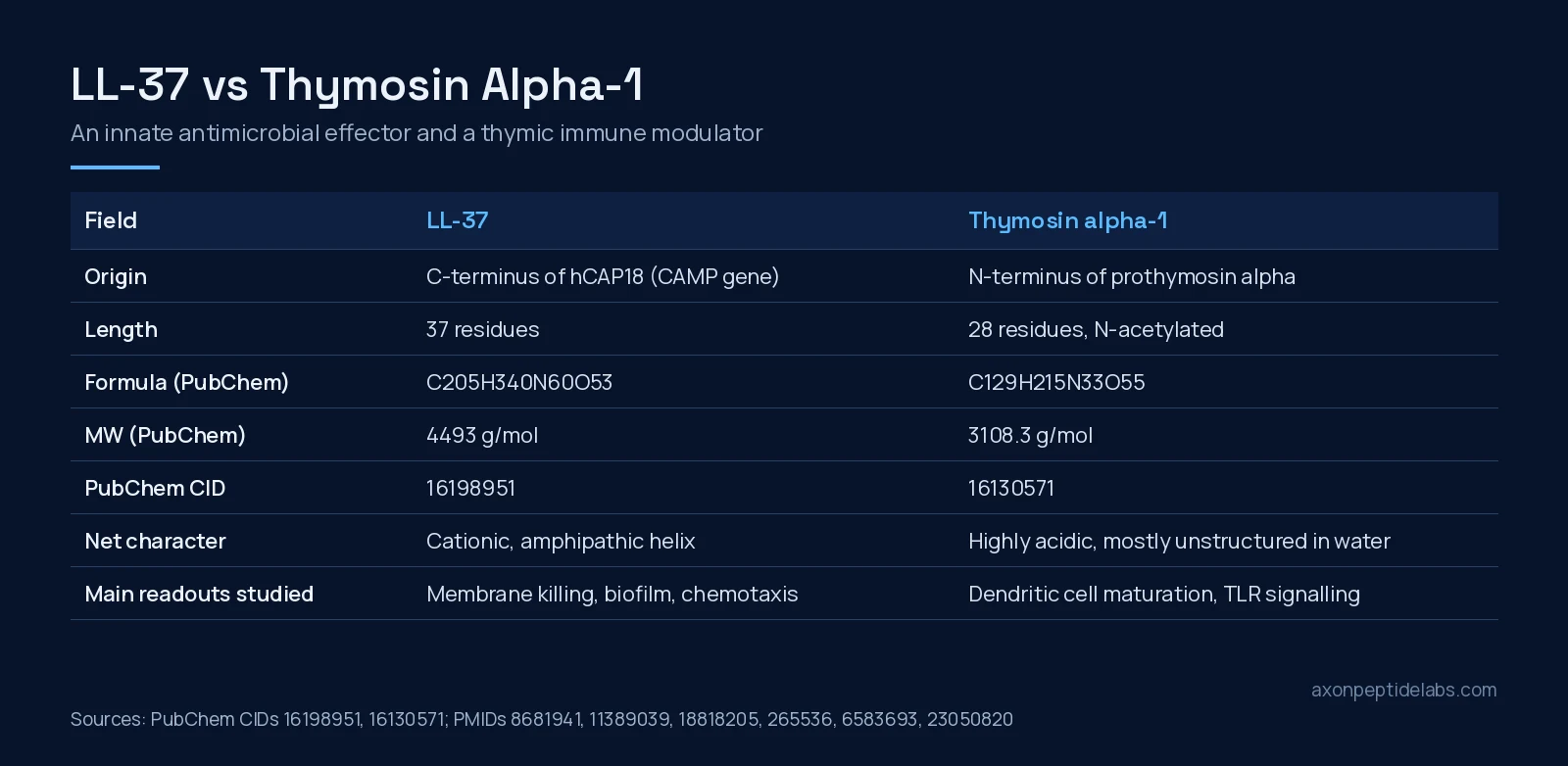
Identity table
Values come from PubChem records, not from certificates of analysis.
| Field | LL-37 | Thymosin alpha-1 |
|---|---|---|
| PubChem CID | 16198951 | 16130571 |
| PubChem title / INN | LL-37 (INN ropocamptide) | Thymalfasin |
| Other names (PubChem) | cathelicidin LL-37, CAP18, FA-LL-37 | thymosin alpha1, Zadaxin |
| CAS (PubChem synonym) | 154947-66-7 | 62304-98-7 |
| Molecular formula | C205H340N60O53 | C129H215N33O55 |
| Molecular weight | 4493 g/mol | 3108.3 g/mol |
| Sequence (PubChem) | LLGDFFRKSKEKIGKEFKRIVQRIKDFLRNLVPRTES | Ac-SDAAVDTSSEITTKDLKEKKEVVEEAEN |
| Termini | free N-terminus, free C-terminal acid | N-acetyl serine, free C-terminal acid |
Count the charges in the two sequences and the contrast is obvious: LL-37 is rich in lysine and arginine, while thymosin alpha-1 is rich in aspartate and glutamate. The 1977 sequencing paper described thymosin alpha-1 as a heat-stable, highly acidic molecule of 28 residues[15]. That charge difference matters at the bench: the two behave very differently on ion-exchange media and in salt-containing buffers, and a mass spectrum separates them easily (about 1,385 g/mol apart).
Where each peptide comes from
LL-37: cut from a cathelicidin precursor
The human cathelicidin was first predicted from a bone-marrow cDNA clone as FALL-39, a cysteine-free peptide unlike the disulfide-bonded defensins known at the time; the synthetic peptide was active against E. coli and B. megaterium[1]. Sequencing the gene showed a compact four-exon structure: exons 1-3 encode the signal sequence and cathelin domain, exon 4 the antimicrobial peptide. The mature peptide isolated from degranulated granulocytes was LL-37, and FALL39 appeared to be the only cathelin-family gene in the human genome[2]. In neutrophils, the holoprotein hCAP18 is cleaved to LL-37 outside the cell after exocytosis, and proteinase 3 was the only azurophil-granule serine protease responsible[3].
The gene is regulated in an unusual way. The CAMP promoter carries a vitamin D response element bound by the vitamin D receptor, and 1,25-dihydroxyvitamin D3 induced CAMP in human cell lines and bone-marrow macrophages, but not in mouse cells[9]. In human macrophages, TLR activation raised expression of the vitamin D receptor and the vitamin D 1-hydroxylase, leading to cathelicidin induction and killing of intracellular Mycobacterium tuberculosis in culture[10]. That species difference is a practical warning for anyone planning mouse work with LL-37.
Thymosin alpha-1: the front end of prothymosin alpha
Thymosin alpha-1 was isolated from calf thymus as one of several peptides in thymosin fraction 5[15]. In 1984 a larger polypeptide of about 112 residues carrying the thymosin alpha-1 sequence at its N-terminus was found to be the main immunoreactive form in rat thymus and was named prothymosin alpha[16]. For a time it was argued that thymosin alpha-1 was only an artefact of proteolysis during extraction, but a 1992 study using extraction conditions that limited proteolysis still found it as a native peptide in calf thymus and several rat tissues[17].
Structure: a membrane-active helix vs a mostly disordered chain
LL-37 is disordered in water at low concentration but becomes helical when anions such as bicarbonate or sulphate are added or as peptide concentration rises, consistent with oligomer formation. Its antibacterial activity tracked the degree of helicity, and N-terminally shortened versions needed more anion to fold and were less active[4]. A triple-resonance NMR structure in SDS micelles showed a curved amphipathic helix-bend-helix spanning residues 2-31, a bend at Gly14-Glu16 and a disordered C-terminal tail, with the aromatic residues and arginines contacting anionic lipids[5]. Another membrane study found LL-37 resistant to proteolysis in solution and when bound to membranes, and cytotoxic to both bacterial and normal eukaryotic cells in vitro[6].
Thymosin alpha-1 behaves differently. In water it is natively unstructured; helical structure appears only with trifluoroethanol or lipid vesicles[19]. CD and NMR work found partial structure in membrane-like media and, in a water-trifluoroethanol mixture, a beta-turn between residues 5 and 8 and a helix between residues 17 and 24[18]. There is no published evidence in these papers that thymosin alpha-1 lyses membranes the way LL-37 does.
Mechanisms studied in cells and animals
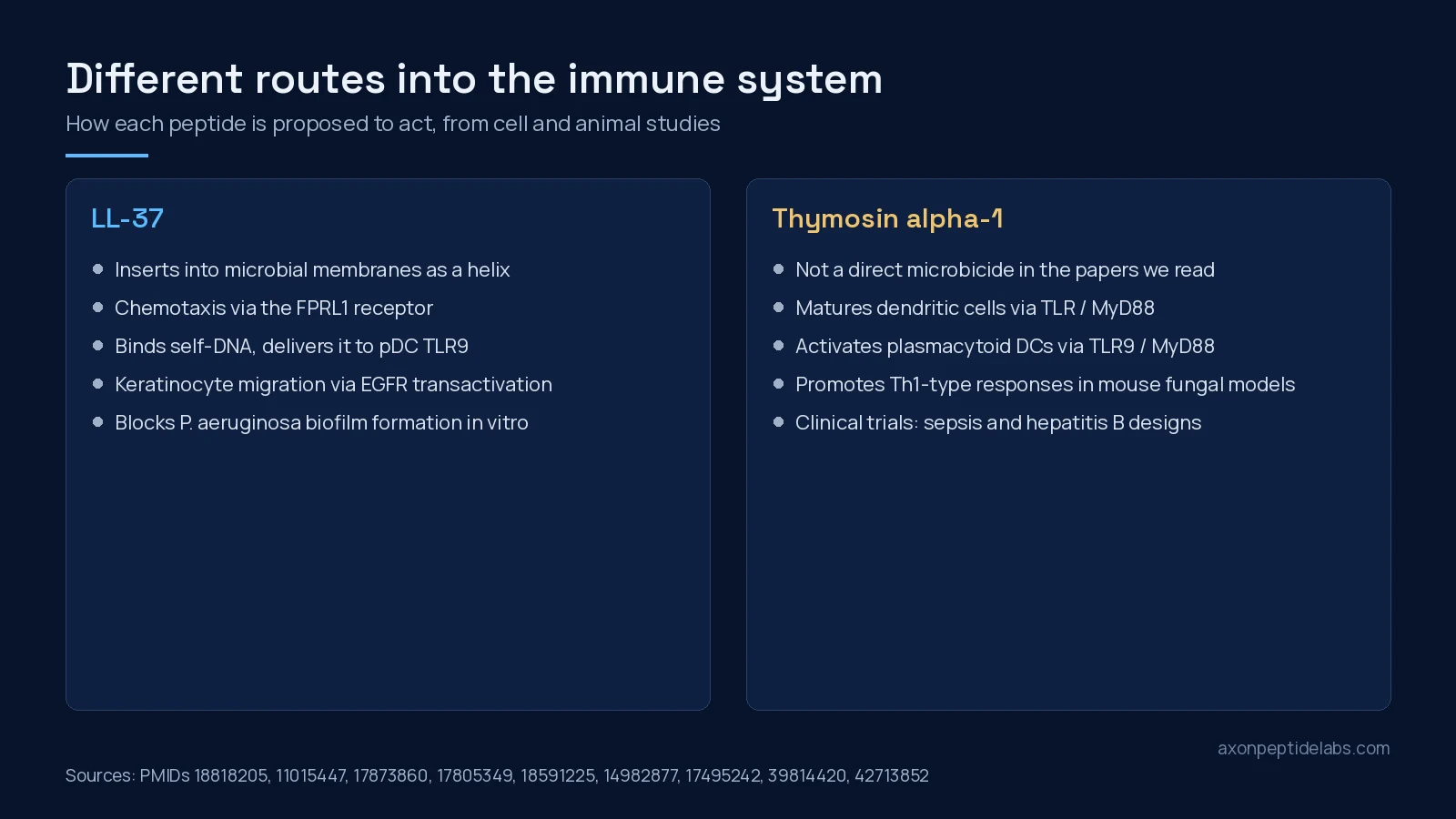
LL-37
- Chemotaxis. LL-37 was chemotactic for human monocytes, neutrophils and T cells and mobilised calcium in cells transfected with formyl peptide receptor-like 1 (FPRL1)[7].
- Nucleic-acid sensing. In work on psoriasis, LL-37 was identified as the factor that let plasmacytoid dendritic cells respond to self-DNA: it bound self-DNA into condensed aggregates that reached early endosomes of those cells and triggered TLR9 and interferon production[8].
- Epithelial repair models. hCAP18 rose sharply in human skin after wounding and was low in chronic ulcer edges; antibodies against LL-37 inhibited re-epithelialisation of organ-cultured human skin[11]. In HaCaT keratinocytes, LL-37 drove migration through EGFR transactivation and FPRL1, and adenoviral LL-37 improved re-epithelialisation of excisional wounds in ob/ob mice[12].
- Biofilms. At concentrations far below those needed to kill Pseudomonas aeruginosa, LL-37 reduced biofilm formation in vitro by lowering attachment, stimulating twitching motility and affecting the Las and Rhl quorum-sensing systems; the mouse cathelicidin CRAMP did not reproduce this[13].
- Host-cell effects. LL-37 induced apoptosis in human airway epithelial cell lines and in mouse airway, and human serum (but not fetal bovine serum) inhibited this[14].
Thymosin alpha-1
- Dendritic cell maturation. Thymosin alpha-1 induced maturation and IL-12 production by fungus-pulsed dendritic cells through p38 MAPK/NF-kB and MyD88-dependent TLR signalling, and in transplanted mice it was linked to Th1-type antifungal resistance in an aspergillosis model[20].
- Plasmacytoid dendritic cells. A review from the same group described activation of plasmacytoid DCs through TLR9/MyD88 and interferon regulatory factor 7[21].
- Broad immune-cell effects. A 2016 review summarised action through TLRs in myeloid and plasmacytoid dendritic cells and effects across several immune-cell subsets[22].
Side-by-side comparison
| Question | LL-37 | Thymosin alpha-1 |
|---|---|---|
| Precursor | hCAP18, cleaved by proteinase 3[3] | Prothymosin alpha[16] |
| Charge character | Cationic | Highly acidic[15] |
| Shape in water | Disordered at low concentration; helical with anions[4] | Unstructured; partial helix only in membrane-like media[19][18] |
| Direct antimicrobial action | Yes, membrane-active[1][5] | Not reported in these sources |
| Main host-cell targets studied | FPRL1, EGFR, pDC TLR9 via DNA complexes[7][12][8] | TLR/MyD88 in myeloid and plasmacytoid DCs[20][21] |
| Known liabilities in vitro | Cytotoxic to eukaryotic cells; serum-sensitive effects[6][14] | None highlighted in these abstracts |
| Mouse model caveat | CAMP not vitamin-D-induced in mouse cells; CRAMP differs[9][13] | Synthetic peptide tested directly in mice[20] |
Human trials: design and results as reported
LL-37 has no large randomized trial among the sources here. Thymosin alpha-1 does. The TESTS trial was a multicentre, double-blind, placebo-controlled phase 3 study in adults with sepsis with 28-day all-cause mortality as the primary endpoint; it found no clear evidence that thymosin alpha-1 lowered that endpoint[23]. A 2026 Cochrane review of thymosin alpha-1 in chronic hepatitis B judged the evidence of very low certainty for almost all outcomes and could not say whether it changes mortality or adverse events[24]. We report these as null or uncertain results only; this article makes no claim about any effect in people.
Can they be combined in one molecule?
One study fused the two ideas. Researchers built eight hybrid peptides from the active regions of antimicrobial peptides, including LL-37(13-36), and either thymopentin or thymosin alpha-1(17-24); the LL-37-thymosin alpha-1 hybrid (LTA) had the best anti-inflammatory activity with low cytotoxicity in screening and reduced inflammatory markers in a mouse model of LPS-induced intestinal inflammation[25]. That is a single design paper in mice, but it is the clearest example of researchers treating the two as complementary rather than interchangeable.
What the evidence does not show
- It does not show the two peptides do the same job. Their structures, charges and receptors differ, and no study we found compared the native peptides head to head.
- It does not show LL-37 is harmless to host cells. It was cytotoxic to normal eukaryotic cells and induced airway epithelial apoptosis in vitro[6][14].
- It does not show that mouse results transfer cleanly. Vitamin D regulation of CAMP was not seen in mouse cells, and mouse CRAMP did not copy LL-37’s anti-biofilm effect[9][13].
- It does not show a defined receptor for thymosin alpha-1. The work points to TLR/MyD88 signalling in dendritic cells[20][22], but these abstracts identify no single high-affinity receptor.
- It does not show clinical benefit. The largest thymosin alpha-1 sepsis trial was null on its primary endpoint, and the hepatitis B evidence is very uncertain[23][24].
Documentation at Axon
Axon carries LL-37 and Thymosin Alpha-1 10mg; the latter sits in the immune peptide category, and our thymosin alpha-1 research hub collects the related reading. No certificate is posted for this product on our COA page at the time of writing, for either LL-37 or Thymosin Alpha-1; check the COA page for any report added later. For a different thymosin comparison, see Thymosin Alpha-1 vs TB-500. When you are ready, you can buy lab-tested peptides in Canada.
Frequently asked questions
What is the main difference between LL-37 and thymosin alpha-1?
LL-37 is a cationic 37-residue peptide cut from the cathelicidin hCAP18 that kills microbes by acting on their membranes and also signals to host cells. Thymosin alpha-1 is a highly acidic, N-acetylated 28-residue peptide from prothymosin alpha that has been studied as a modulator of dendritic cells through TLR/MyD88 signalling.
Is thymosin alpha-1 an antimicrobial peptide like LL-37?
Not in the sources we reviewed. LL-37 has direct activity against bacteria in vitro, while thymosin alpha-1’s research focuses on immune-cell signalling, such as dendritic cell maturation and Th1-type responses in mouse fungal models.
How is LL-37 produced in the body?
The human CAMP (FALL39) gene encodes hCAP18. In neutrophils, hCAP18 is cleaved outside the cell by proteinase 3 to release LL-37. The CAMP promoter carries a vitamin D response element, and vitamin D induces the gene in human but not mouse cells.
Do LL-37 and thymosin alpha-1 both involve TLR9?
Yes, but differently. LL-37 binds self-DNA and carries it into plasmacytoid dendritic cells, where TLR9 is triggered. Thymosin alpha-1 has been reported to activate plasmacytoid dendritic cells through TLR9/MyD88 signalling itself.
Has thymosin alpha-1 been tested in large clinical trials?
Yes. The phase 3 TESTS trial in adults with sepsis found no clear evidence of lower 28-day mortality, and a 2026 Cochrane review rated the hepatitis B evidence as very low certainty. These are reported here as research findings only.
Does Axon post a COA for LL-37 or Thymosin Alpha-1?
No certificate is posted for either product on the Axon COA page at the time of writing. Check the COA page for any report added later.
References
- Agerberth B, Gunne H, Odeberg J et al. (1995). FALL-39, a putative human peptide antibiotic, is cysteine-free and expressed in bone marrow and testis. Proc Natl Acad Sci U S A. PMID: 7529412. doi: 10.1073/pnas.92.1.195.
- Gudmundsson GH, Agerberth B, Odeberg J et al. (1996). The human gene FALL39 and processing of the cathelin precursor to the antibacterial peptide LL-37 in granulocytes. Eur J Biochem. PMID: 8681941. doi: 10.1111/j.1432-1033.1996.0325z.x.
- Sørensen OE, Follin P, Johnsen AH et al. (2001). Human cathelicidin, hCAP-18, is processed to the antimicrobial peptide LL-37 by extracellular cleavage with proteinase 3. Blood. PMID: 11389039. doi: 10.1182/blood.v97.12.3951.
- Johansson J, Gudmundsson GH, Rottenberg ME et al. (1998). Conformation-dependent antibacterial activity of the naturally occurring human peptide LL-37. J Biol Chem. PMID: 9452503. doi: 10.1074/jbc.273.6.3718.
- Wang G (2008). Structures of human host defense cathelicidin LL-37 and its smallest antimicrobial peptide KR-12 in lipid micelles. J Biol Chem. PMID: 18818205. doi: 10.1074/jbc.M805533200.
- Oren Z, Lerman JC, Gudmundsson GH et al. (1999). Structure and organization of the human antimicrobial peptide LL-37 in phospholipid membranes: relevance to the molecular basis for its non-cell-selective activity. Biochem J. PMID: 10417311.
- De Yang, Chen Q, Schmidt AP et al. (2000). LL-37, the neutrophil granule- and epithelial cell-derived cathelicidin, utilizes formyl peptide receptor-like 1 (FPRL1) as a receptor to chemoattract human peripheral blood neutrophils, monocytes, and T cells. J Exp Med. PMID: 11015447. doi: 10.1084/jem.192.7.1069.
- Lande R, Gregorio J, Facchinetti V et al. (2007). Plasmacytoid dendritic cells sense self-DNA coupled with antimicrobial peptide. Nature. PMID: 17873860. doi: 10.1038/nature06116.
- Gombart AF, Borregaard N, Koeffler HP (2005). Human cathelicidin antimicrobial peptide (CAMP) gene is a direct target of the vitamin D receptor and is strongly up-regulated in myeloid cells by 1,25-dihydroxyvitamin D3. FASEB J. PMID: 15985530. doi: 10.1096/fj.04-3284com.
- Liu PT, Stenger S, Li H et al. (2006). Toll-like receptor triggering of a vitamin D-mediated human antimicrobial response. Science. PMID: 16497887. doi: 10.1126/science.1123933.
- Heilborn JD, Nilsson MF, Kratz G et al. (2003). The cathelicidin anti-microbial peptide LL-37 is involved in re-epithelialization of human skin wounds and is lacking in chronic ulcer epithelium. J Invest Dermatol. PMID: 12603850. doi: 10.1046/j.1523-1747.2003.12069.x.
- Carretero M, Escámez MJ, García M et al. (2008). In vitro and in vivo wound healing-promoting activities of human cathelicidin LL-37. J Invest Dermatol. PMID: 17805349. doi: 10.1038/sj.jid.5701043.
- Overhage J, Campisano A, Bains M et al. (2008). Human host defense peptide LL-37 prevents bacterial biofilm formation. Infect Immun. PMID: 18591225. doi: 10.1128/IAI.00318-08.
- Lau YE, Bowdish DM, Cosseau C et al. (2006). Apoptosis of airway epithelial cells: human serum sensitive induction by the cathelicidin LL-37. Am J Respir Cell Mol Biol. PMID: 16340000. doi: 10.1165/rcmb.2005-0170OC.
- Goldstein AL, Low TL, McAdoo M et al. (1977). Thymosin alpha1: isolation and sequence analysis of an immunologically active thymic polypeptide. Proc Natl Acad Sci U S A. PMID: 265536. doi: 10.1073/pnas.74.2.725.
- Haritos AA, Goodall GJ, Horecker BL (1984). Prothymosin alpha: isolation and properties of the major immunoreactive form of thymosin alpha 1 in rat thymus. Proc Natl Acad Sci U S A. PMID: 6583693. doi: 10.1073/pnas.81.4.1008.
- Franco FJ, Diaz C, Barcia M et al. (1992). Thymosin alpha 1 is a native peptide in several tissues. Biochim Biophys Acta. PMID: 1554740. doi: 10.1016/0167-4838(92)90422-a.
- Grottesi A, Sette M, Palamara T et al. (1998). The conformation of peptide thymosin alpha 1 in solution and in a membrane-like environment by circular dichroism and NMR spectroscopy. A possible model for its interaction with the lymphocyte membrane. Peptides. PMID: 9880079. doi: 10.1016/s0196-9781(98)00132-6.
- Volk DE, Tuthill CW, Elizondo-Riojas MA et al. (2012). NMR structural studies of thymosin α1 and β-thymosins. Ann N Y Acad Sci. PMID: 23050820. doi: 10.1111/j.1749-6632.2012.06656.x.
- Romani L, Bistoni F, Gaziano R et al. (2004). Thymosin alpha 1 activates dendritic cells for antifungal Th1 resistance through toll-like receptor signaling. Blood. PMID: 14982877. doi: 10.1182/blood-2003-11-4036.
- Romani L, Bistoni F, Montagnoli C et al. (2007). Thymosin alpha1: an endogenous regulator of inflammation, immunity, and tolerance. Ann N Y Acad Sci. PMID: 17495242. doi: 10.1196/annals.1415.002.
- King R, Tuthill C (2016). Immune Modulation with Thymosin Alpha 1 Treatment. Vitam Horm. PMID: 27450734. doi: 10.1016/bs.vh.2016.04.003.
- Wu J, Pei F, Zhou L et al. (2025). The efficacy and safety of thymosin α1 for sepsis (TESTS): multicentre, double blinded, randomised, placebo controlled, phase 3 trial. BMJ. PMID: 39814420. doi: 10.1136/bmj-2024-082583.
- Naing C, Ni H, Aung HH et al. (2026). Thymosin-ɑ1 for people with chronic hepatitis B. Cochrane Database Syst Rev. PMID: 42713852. doi: 10.1002/14651858.CD014610.pub2.
- Zhang L, Wei X, Zhang R et al. (2019). Design and Development of a Novel Peptide for Treating Intestinal Inflammation. Front Immunol. PMID: 31447849. doi: 10.3389/fimmu.2019.01841.